How to hire a SaaS pricing consultant
Pricing is one of the hardest projects a software company ever runs, and almost nobody is set up to run it.
Start with how little attention it gets. ProfitWell analyzed 3,000+ SaaS companies and found something absurd: the average company spends six hours total on pricing over its entire lifetime. Six hours. Less than most teams spend choosing office supplies.
Then look at what happens when a company finally decides to take it seriously. 72% of pricing initiatives fail, according to Gartner. The root cause is almost never the price points. It’s a weak pricing model. It’s internal misalignment. It’s change management. It’s recommendations that never survive contact with the sales floor.
That’s what you’re hiring against. Not the analysis. The execution.
This guide covers what a pricing consultant actually does, why most pricing projects fail, the questions to ask before you hire one, the red flags worth walking away from, and what the work costs.
Pricing strategy is a six-layer architecture
Most people think pricing means picking the right number. Adjusting a dollar amount on the pricing page. Maybe adding a tier.
That’s the tiny tip of the iceberg. The real strategy sits underwater, and every layer below the surface needs to make sense before you ever type a dollar sign.
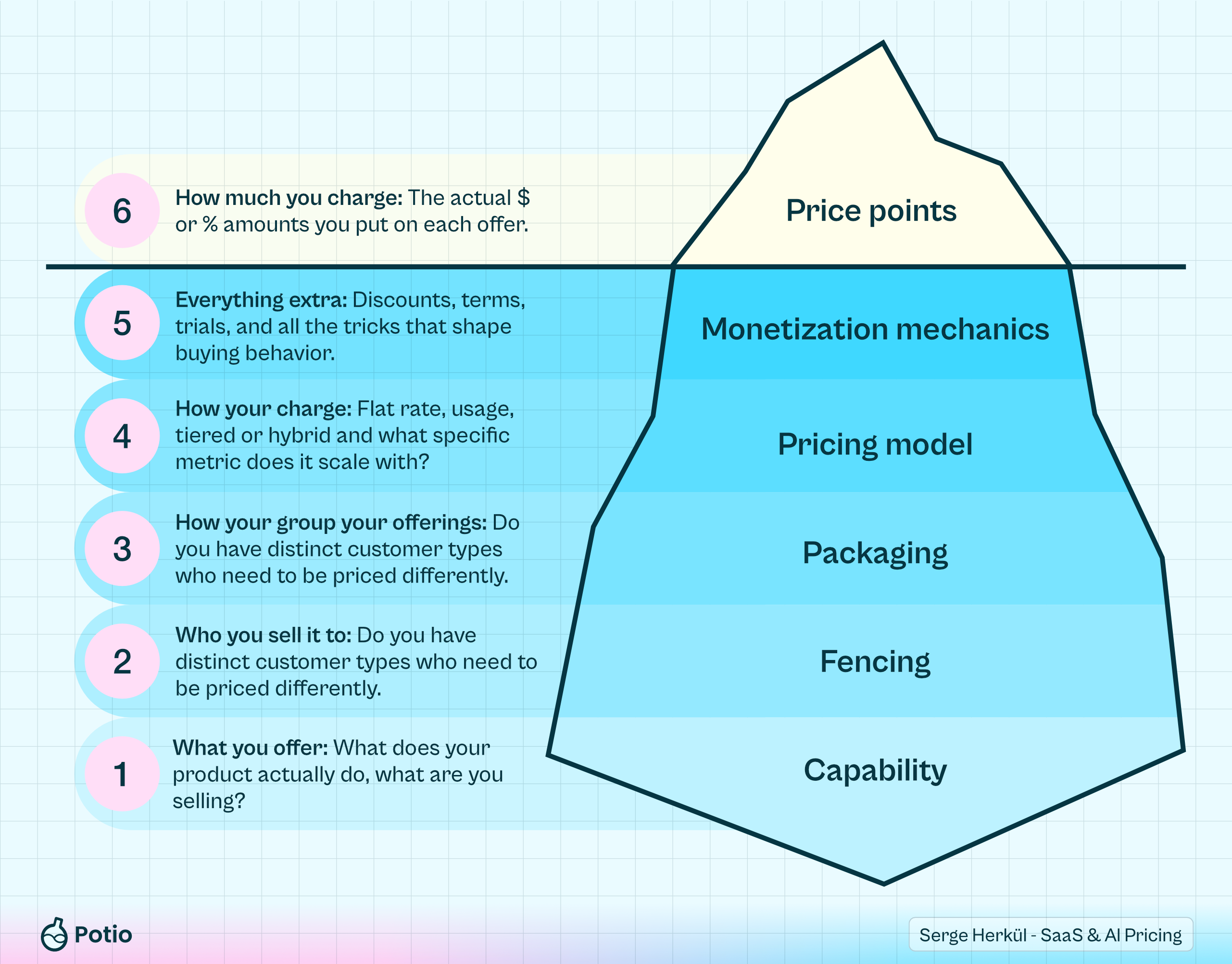
Here’s how I think about pricing architecture:
- Capability. What does your product actually do, what are you selling?
- Fencing. Who are you selling to? Do you have fundamentally different customer types that need different pricing?
- Packaging. How you bundle and group your offerings. This is where you build tiers, ladders and add-ons.
- Pricing model. How you charge. Flat rate, usage-based, tiered, hybrid. The key is finding the value metric that connects price to actual customer value.
- Monetization mechanics. The invisible levers. Discounts, trials, billing terms. They shape buying behavior before a customer ever sees a number.
- Price points. The actual $/€/£ or percentage amounts. Last on the list for a reason.
If your packaging is broken, no price point saves you. If your value metric is off, your pricing won’t make sense regardless of what you charge.
This matters for choosing a consultant because most of the value lives in layers 1 through 4. Someone working only at the price-point layer is solving the wrong problem. Updating a number on your pricing page takes an afternoon. Rebuilding your pricing structure is a cross-functional project touching every department in your company.
Which is also why most people arrive with the wrong diagnosis. A founder books a call to talk about whether the top tier should be $49 or $59, and an hour in it’s clear the actual problem is that three completely different customer types are being sold the same package.
That’s normal and it’s not a failure on their part. Layer 6 is the only layer you can see from outside your own company. You can’t tell from your pricing page whether your packaging is broken, so don’t try to rule yourself in or out of hiring help on that basis. What you can judge is whether you’re in a position to run the project at all.
Layer 4 is the one that constrains everything above it, because the unit you bill on decides what your packaging can even look like.
Layer 3 is where most companies lose money quietly. A broken package can’t be rescued by any price point, which is why the shape of your tier ladder deserves more attention than the numbers printed on it.
Why most pricing projects fail
81% of SaaS companies plan pricing changes annually, but only 34% successfully achieve their pricing goals (Simon-Kucher). That’s a staggering gap, and the data on why is consistent across every major research firm.
Nobody owns pricing
Pricing touches product, sales, marketing, finance and engineering. In most organizations there’s nobody senior enough to push a change through all of them. The work falls to the CEO, who has no bandwidth, or to a product manager, who has no cross-functional authority.
Without C-suite sponsorship, pricing initiatives are 3.5x less likely to succeed (Bain). Stakeholder involvement from the beginning increases adoption by 70% (Prosci). These aren’t small effects, and neither of them is about the quality of the model.
The implementation gap
More than two-thirds of large tech transformation programs fail to be delivered on time, within budget or within scope (BCG). Pricing projects do worse, because they’re usually nobody’s day job.
The default outcome of a consulting engagement is shelfware. A polished deck full of theoretical recommendations the organization is fundamentally unable to execute. This is the central thing to understand about pricing consulting: it’s not only about the strategy, it’s about getting it live.
Sales resists, and they’re not wrong to
Sales teams are naturally resistant to pricing changes. They fear new packaging will depress win rates, lengthen sales cycles and hurt their commissions. In the first quarter they’re often right.
A pricing consultant ends up operating as an organizational psychologist as much as an economist. 70% of change initiatives fail on human resistance, not flawed math. That’s the actual failure mode.
Pricing gets revisited far too rarely
The average SaaS company updates pricing every 2.7 years (ProfitWell). Better companies optimize quarterly. The fastest moving companies change pricing monthly (OpenAI changed pricing 12 times last year).
If your pricing strategy is adjusting numbers every couple of years, you don’t have a pricing strategy, and you’re underperforming your potential.
The takeaway for hiring is simple. Look for someone senior, ideally a past executive, who’s comfortable getting pricing through your entire org. And watch out for career consultants who’ve never been on the receiving end of a pricing change inside a real company.
What a pricing consultant actually does
The main job is to help you build and implement a winning pricing architecture. The six layers above, made concrete for your specific business.
Price architecture
The core deliverable. The structural design of your tiers, modular add-ons and value metrics. Which features go in which plans. What separates the $50/month customer from the $500/month customer. How your packaging creates natural upgrade paths. How to structure that new AI credit system.
Good pricing architecture doesn’t only capture more revenue. It makes selling easier. Sales reps know exactly what to pitch to whom. Customers self-select into the right tier. Expansion happens without anyone negotiating it.
Financial modeling
A strong consultant can do both top-down and bottom-up modeling.
Top-down, or deterministic, starts from revenue targets and works backward. What price levels and conversion rates are needed to hit the number.
Bottom-up, or probabilistic, builds from individual customer behavior, usage patterns and conversion assumptions to project revenue forward, and gives you a range instead of a single figure.
Ask which one they’ll run. If the answer is a single spreadsheet with one revenue line at the bottom, you’re buying a guess with formatting.
Discounting governance
Many companies have a discount problem they don’t fully see. Reps trade margin for volume because there’s no framework telling them when a discount is justified and when it isn’t. A pricing consultant establishes the guardrails: maximum discount thresholds by deal size, approval workflows for exceptions, and visibility into how discounting affects your actual realized price.
There’s a second half to this that most engagements skip. Change the packaging and you change what a rep earns per deal. Leave comp alone and you’ve built an incentive to keep selling the old shape.
Systems and rollout
The operational layer that strategy-only consultants skip entirely. Blueprints for getting new pricing into your CRM, CPQ and billing engine, whether that’s Stripe Billing, Metronome, Orb, Lago or Maxio. Sales enablement and objection-handling guides. Customer communication templates. Legacy migration plans that don’t trigger mass churn.
This is where more pricing work dies than anywhere else. Everyone signs off on the strategy, then it turns out billing can’t express tier three without six weeks of engineering nobody scheduled. Ask early what the model requires from your stack, and ask your engineers whether that’s real.
If someone offers to fix your pricing in two weeks, that tells you what you need to know. The deliverable should be a pricing system you can run, not a PDF you can file.
5 questions to ask before hiring a pricing consultant
How would your approach change for my business?
You’re testing whether they have a method or a template.
A good answer gets specific about you, fast. A PLG product with a self-serve funnel needs completely different packaging logic than an enterprise product with a 90-day sales cycle. A company bolting AI onto an existing subscription has a margin problem a traditional SaaS tool doesn’t. Someone who’s thought about your business names one of these before you do.
A bad answer describes their process. If what comes back is a numbered methodology with the same five phases everyone else gets, the output reflects the median case, not yours.
Have you carried a P&L?
The consultant needs to be someone your executive team takes seriously. Ideally someone who’s been an executive themselves and knows firsthand what it takes to push a cross-functional project through a company.
Bain’s data shows active C-suite sponsorship makes pricing initiatives 3.5x more likely to succeed. The consultant has to earn and keep that sponsorship, which means sitting in a room with your CEO, CRO and CPO, understanding their competing priorities and aligning them on one direction. Junior analysts can’t do this. Career consultants who’ve never run a P&L struggle with it.
How many clients are you running right now, and who does the work?
Ask both halves, and get names.
This is the most common bait-and-switch in consulting. A senior partner runs the pitch, the engagement gets staffed with analysts two or three years out of school, and you find out in week three. Large firms are built this way. It isn’t a scandal, it’s their operating model. You just need to know before you sign, because you’re paying senior rates either way.
Parallel client count matters for the same reason. The engagement should feel like adding a senior member to your team, not buying a productized service.
What do you know about my model that a generalist doesn’t?
Subscription mechanics matter. Net dollar retention, churn dynamics, expansion revenue, LTV/CAC and billing system constraints. Experience with both PLG and sales-led motions matters too, because the architecture differs a lot between them.
You don’t need someone from your exact vertical. A consultant who works only in “productivity SaaS” or “legal tech” has narrowed on the wrong axis. Expansion revenue behaves the same across verticals. The value metric is what differs, and that’s discoverable in a couple of weeks by anyone competent.
What do I have on the last day?
Make them list it before you sign.
Tier definitions and value metrics you can ship. Discounting governance your deal desk can run. CRM and billing configuration specs. Sales playbooks with objection handling. Customer communication templates. A migration plan for existing accounts.
Forrester attributes 35% of pricing initiative failures specifically to inadequate systems support, meaning the model was right but never made it into the billing system or the sales playbook. If the engagement ends with a slide deck and a handshake, the strategy dies on arrival.
Worth adding a sixth ask: a call with a past client. Not a polished case study, an honest conversation. How hands-on were they? Did the recommendations survive contact with reality? Would the client hire them again?
Red flags when evaluating pricing consulting firms
The cost of a failed pricing engagement goes beyond the fee. It’s the lost momentum, the eroded customer trust and the organizational whiplash.
Solutions before diagnosis
The most reliable red flag is a consultant who prescribes a pricing model in the first conversation, before they deeply understand your business or examine your sales data, customer segments or expansion metrics. They’re not solving your problem. They’re applying the last client’s solution to your business.
Every business is different. Different customer types, different GTM motions, different competitive dynamics, different unit economics. Every engagement has to be different too. A good consultant has a strong base framework as a starting point, then morphs the work to fit the company. If they show up with answers before they’ve looked at your data, walk away.
The slide deck merchant
These consultants take your data, disappear for a few weeks and come back with an 80-page deck. The presentation is polished. The frameworks look impressive. But somewhere between the kickoff call and the big reveal, they stopped talking to you.
The problem isn’t the deck. Good engagements produce decks too. The problem is when the deck is the engagement. You sit through the presentation, nod along, then realize nobody on your team actually learned how to think about pricing. The consultant leaves, the deck goes into a shared drive and nothing changes.
In a good engagement the work happens in working sessions, not in a final presentation. You’re in the room when trade-offs get debated. Your sales lead pushes back on packaging assumptions in real time. By the time anything gets put into slides, the team already understands the logic because they helped build it.
If a consultant is more attached to their proprietary matrix than to discovering your market reality, disqualify them.
Over-reliance on competitor benchmarking
80% of the time, focusing on what competitors charge is actively harmful. Your competitors are at different growth stages. They have different capital structures, and a VC-backed company burning cash for market share prices very differently from a bootstrapped company optimizing for profitability. And there’s no reason to assume they price well.
You should aim to beat competitors in pricing, the same way you aim to beat them in product, marketing and sales.
Competitors are relevant in one specific situation: when you hear about them through sales, when prospects literally say “I’m going to X because they price like Y.” Short of that, competitor pricing pages are noise.
ProfitWell’s research confirms underpricing is 2x more common than overpricing among SaaS companies, and significantly harder to correct after the fact. A consultant who centers the engagement on your competitors is steering you toward the same mistake everyone else made.
Over-reliance on pricing research
Van Westendorp is the most discussed willingness-to-pay method in pricing circles. Yet Irrational Labs found that only 8 out of 60 software companies surveyed had actually used it.
More importantly, any competent team can run these surveys themselves. You don’t need to pay an arm and a leg for it. And asking someone what they’d pay for something is very different from asking for a credit card. The gap between “I’d pay $50” and actually clicking buy at $50 is where pricing research breaks down, and the error runs in both directions.
It’s fake comfort, because pricing is inherently a bet. There’s no single right way to price your product. There are many great ways, but no single right one, and the only way to validate it is to test it on the market.
From my own early experience with Van Westendorp: I took the results, gut-checked them and realized they didn’t make sense. Then doubled the optimal prices, only to land at almost 100% growth increase compared to those optimals.
If a consultant’s value proposition is their WTP research methodology, that’s a red flag, not a selling point.
What changes when you’re pricing AI features
Traditional SaaS has near-zero marginal costs and runs at 80%+ gross margins, so even sloppy pricing mostly costs you upside. AI breaks this. Every query burns compute, costs scale with usage, and a power user can consume 100x more than a casual one on the same flat subscription. Margins on AI features swing from -50% to +80% across a customer base.
The buyer side is harder than most vendors expect. An AI founder on r/startups described the resistance directly:
if I tell businesses: “Oh your cost may vary based on what you use”, it is just not selling well because businesses have to “plan” a budget for a year and this budget cannot vary from: “Oh this month we might get a $100 bill but next month we might get $10,000 bill if we use more”
So you’re designing against two constraints at once. Your margin needs usage to matter. Your buyer needs the invoice to be predictable. Most AI products land on a committed base plus an included credit allowance and metered overage, which is the shape a phone plan has had for thirty years.
Pricing this well requires understanding infrastructure costs, token economics and how usage patterns map to your cloud bill. A consultant with an engineering background asks different questions than one with an MBA. They’ll dig into your cost-to-serve data before touching the packaging, and they’ll understand why a credit needs to map to actual compute rather than just look clean on a pricing page. AI unit economics is its own discipline now, and anyone treating it as a footnote will get your margins wrong.
When to hire a pricing consultant
Five situations where external pricing expertise consistently pays off.
Architectural shifts. Moving from a seat-based subscription to a hybrid or usage-based model. This changes your billing infrastructure, sales comp, customer communication and financial forecasting all at once.
Product expansion. Going from a single product to a multi-product platform that needs bundled pricing. The packaging complexity jumps dramatically.
AI integration. Monetizing high-cost AI features without cannibalizing gross margins.
M&A activity. Rationalizing two pricing models after an acquisition. Two products, two pricing philosophies, one go-to-market motion.
Legacy pricing debt. Grandfathered cohorts that quietly become a large share of revenue. A founder on r/SaaS put numbers on it:
2 years later, 23% of revenue comes from plans I don’t sell anymore… Those customers pay on average 40% less than new customers for the same features.
They migrated the cohort and lost 15% of it, which they called expected and acceptable. That’s the trade, and it gets more expensive every quarter you leave it. Moving legacy customers onto current pricing without triggering a churn event is a specific skill.
When to wait
None of the reasons to hold off are about your ARR. They’re all about whether the change can survive your company right now.
Nobody senior is going to be in the room. The single best predictor of failure. Bain puts C-suite sponsorship at 3.5x more likely to succeed and Prosci puts early stakeholder involvement at 70% better adoption. The test is concrete: will your CEO sit in the working sessions, or are you planning to present the conclusion to them afterwards? If it’s the second one, fix that before you spend anything.
You can’t ship for two quarters. If engineering is committed through the half and billing can’t be touched, you’re buying a plan with no runway. Forrester traces 35% of pricing failures to exactly this. Ask your CTO before you sign, not after.
You want the answer you already have. If the decision is made and what you need is something to show the board, somebody will sell you that document. It won’t move revenue and you’ll both know it by month three.
You only want the research. Van Westendorp and Gabor-Granger are cheap to field and your own team can run them. Paying consulting rates for a survey is a bad trade no matter who’s running it.
Revenue share is the only structure you can afford. Almost every established consultancy rejects performance contingencies, because pricing results can’t be separated from product releases, marketing spend and sales performance. Read it the other way round: if upside-only is the only way to fund this, the cash constraint is the bigger problem to solve first.
One more that’s about me rather than about consultants generally. If you already have a director of pricing, you don’t need an architecture engagement. You need capacity, or a specific second opinion on one decision.
When to build an internal pricing team
Companies crossing roughly $100M ARR should build internal, cross-functional pricing capability. A director of pricing at $250k to $350k all-in makes the economics work at that scale and gives you continuous optimization rather than periodic projects.
Below that, external help gives a higher return. The best long-term approach is both: engage a consultant for the transformation, have them build internal capability alongside the project, then transition to internal ownership with periodic outside check-ins. Pricing is a continuous function, not a one-time project.
What a SaaS pricing consultant costs
Almost nobody in this market publishes fees, which is why this is the hardest thing to find out before you’re already in a sales process. Here’s the shape of it.
| What you’re buying | Fee | Who it fits |
|---|---|---|
| Independent consultants and boutiques | $25,000 to $150,000 | $1M to $50M ARR |
| Large pricing firms | $100,000 to $500,000+ | $50M+ ARR |
| MBB and Big 4 | $200,000 to $1,000,000+ | $100M+ ARR, PE-backed or pre-IPO |
My own engagements start at $8,500 and run past $40,000. Where one lands comes down to scope: how many stakeholders have to end up aligned, whether the work stops at architecture or carries through billing and sales enablement, and how much of your data needs rebuilding before anyone can model anything credible. Current fees are on my services page.
For what the large end feels like from the buyer’s side, a B2B software executive described a Price Intelligently engagement on r/SaaS:
They certainly weren’t cheap. I think all told we paid like $120,000 for 3 modules which gave us personas pricing and packaging. So it was like 40 grand per module.
Good process, real rigor, and a number that only makes sense above a certain ARR.
One thing worth reading into a fee structure. If a firm won’t give you a number before a discovery call, the number depends on what they conclude you can pay. Firms are entitled to work that way. It’s also information about what you’re buying.
List of pricing consulting companies
The market segments into distinct tiers, and choosing the wrong tier for your stage wastes money or delivers irrelevant recommendations.
| Firm | Delivery model | Typical client | Best known for |
|---|---|---|---|
| Potio | Founder-led, small senior team | $1M to $50M ARR SaaS and AI | Credit and usage architecture, AI margins, billing alignment |
| Pricing I/O | Agency, around 25 people | $10M to $100M+ ARR | Packaging design, per-seat to usage transitions, CEO coaching |
| Valueships | Firm, 10 to 49 people | $1M to $50M ARR | Price elasticity modeling, AI unit costs, legacy migrations |
| Monetizely | Small senior team | $5M to $100M+ ARR | CPQ, discount controls, three-part tariffs for generative AI |
| Willingness to Pay | Boutique, senior-only | $5M ARR to $1B+ revenue | Price structure redesign, perpetual-to-SaaS transitions, PE portfolios |
| Pace Pricing | Solo to micro practice | $1M to $50M+ ARR | Value metric discovery, packaging simplification |
| AcuStrategy | Small boutique | $5M to $100M ARR | Value-based segmentation, pricing governance |
| Software Pricing Partners | Boutique | $10M to $100M+ ARR | Enterprise contract mechanics, value realization before an exit |
| SBI Growth (Price Intelligently) | 100+ consultants | $20M to $250M+ ARR | Modular packaging and persona research |
| Simon-Kucher | 2,000+ people, 30+ countries | $50M+ ARR | Conjoint analysis, global price harmonization |
| McKinsey, Bain, BCG, Deloitte | Global partnerships | $100M+ ARR | Transformations, private equity commercial due diligence |
SaaS-specific independents and boutiques
The sweet spot for most companies up to $50M ARR. These consultants live in subscription metrics, know your billing stack and have experience with both PLG and sales-led motions. The best ones focus on work you can actually ship, not frameworks you can admire. The risk is capacity, because one person has a ceiling and a small team can be running more accounts in parallel than the website suggests.
Large pricing firms
Firms like Simon-Kucher bring pattern recognition from thousands of engagements and deep proprietary data. The risk is staffing. Unless you secure a senior partner on your project, the actual work gets done by people two or three years out of school. Before signing, ask to meet whoever will actually do the work.
Best suited above $50M ARR, especially with a global sales organization and multiple regions. Below that, the economics don’t work and the engagement assumes organizational complexity you don’t have yet.
MBB and Big 4
McKinsey, Bain, BCG and Deloitte have strong pricing practices, but they’re built for PE-backed situations, pre-IPO companies and large-scale transformations at $100M+ ARR. If you’re a 25-person company, you’re not their target client and their recommendations will reflect that.
SaaS pricing consultant vs software pricing consultant
The terms get used interchangeably and search engines treat them as the same thing. They’re not quite the same trade.
Software pricing consultants often come out of perpetual license and maintenance-renewal work. License metrics, entitlement, enterprise agreements, channel margin. That expertise is real and it matters if you sell six-figure on-premise deals.
SaaS pricing runs on different mechanics: net revenue retention, expansion inside an account, self-serve conversion, churn, and increasingly the cost of serving a single query. If you run a subscription business, ask which of the two a firm does day to day. The words on their homepage won’t tell you.
Conclusion
The biggest risk when hiring a pricing consultant is choosing someone who delivers a generic slide deck without an implementation plan.
The right pricing consultant adapts their approach to your specific business, has the seniority to align your executive team, understands SaaS and AI economics, and builds something you can actually ship. They become a temporary partner embedded in how your company works, not a vendor delivering a deck from the outside.
That’s the approach I take at Potio. I’ve been a founder or CEO in five companies, including Toggl, and I’ve gone through pricing transformations in every one of them. If you want pricing you can ship, built by a partner who’s sat in your seat, that’s what I do.
FAQ
Should I hire a solo pricing consultant or an agency?
Below $50M ARR a solo operator or small boutique is usually the better trade, provided they’ve actually held an executive seat. You get the senior person on every call rather than only in the pitch. An agency earns its premium when the work needs parallel workstreams, a research team fielding surveys at volume, or coverage across several regions at once. Either way, ask who does the work by name before you sign.
Will a pricing consultant work for a share of the revenue increase?
Almost none will, and be careful with one who offers. Pricing results can’t be separated cleanly from product releases, marketing spend, sales performance and market conditions, so attribution becomes an argument about a quarter in. Fixed fees keep the incentive on decision quality and speed rather than on a number both sides can dispute.
How do I know whether the engagement actually worked?
Agree the measurement before it starts, and make it something that moves within two quarters. Realized price on new deals, conversion by tier, the share of accounts landing in the tier you designed for them, and expansion revenue that doesn’t require a renegotiation. Total ARR is too slow and too contaminated by everything else you’re doing. If a consultant won’t name a metric up front, that’s its own answer.
Is Simon-Kucher worth it for a small SaaS company?
Usually not. They’re built for $50M+ ARR companies with multiple regions, a real sales organization and an internal pricing function to hand the work to. Below that the engagement assumes organizational complexity you don’t have, the fee is hard to justify against the size of the change, and a senior partner is unlikely to be on your account. Their pattern recognition is real. It’s priced for a different problem.
Can I run the willingness-to-pay research myself?
Yes, and for most companies that’s the right call. Van Westendorp and Gabor-Granger surveys are cheap to field and any competent product or growth person can run them. Treat the output as one input rather than an answer, because stated willingness to pay diverges from behavior once a card is required. Outside help earns its fee turning research into packaging and a pricing model, not collecting it.
Pricing consulting for
SaaS and AI companies.
I'm a 3x founder and former CEO of Toggl. I work hands-on with SaaS & AI teams to fix pricing, packaging and monetization.
Book a call