Pricing consultants: the firms, the fees and how to choose
Every ranking of pricing consultants online is sorted by prestige. Simon-Kucher first, then the big three strategy firms, then whoever paid for the badge. You can read all of them and still not know what an engagement costs, or whether the firm would even take your call.
Most of the firms on those lists will not work with you if you are under $100 million in revenue, and they will never say so on their site. You find out after two calls and a proposal built to be declined.
So I put this one together differently. Same firms, plus the boutique tier the directories leave out, with the numbers attached: fee ranges and where they came from, the staffing math behind the floors, what each firm is actually built for, and the three ways these engagements fall apart after the deck lands.
I run one of the firms on this page, so factor that in. Potio sits in the table with the same columns as everyone else, and there is a short section near the end on which problems it fits and which it does not. The difference that matters is not headcount. It is that I ran software companies for years before I started pricing them for a living.
Pricing consulting firms at a glance
Grouped by what each firm is structurally built to do, not by brand rank. Fee ranges and client bands are explained and sourced in the sections below.
| Firm | Tier | Built for | Client revenue band | Typical project fee |
|---|---|---|---|---|
| McKinsey | Global strategy | Board-level commercial transformation | $1B+ | $800k to $2M+ |
| BCG | Global strategy | Pricing tied to digital transformation | $1B+ | $500k to $1.2M+ |
| Bain | Global strategy | Private equity diligence, retention analytics | $500M+ and PE-owned | $450k to $3M |
| Simon-Kucher | Enterprise pricing specialist | Willingness to pay research, packaging design | $100M+ | $300k to $600k |
| Deloitte | Big Four and integrators | Pricing governance plus CPQ and ERP rollout | $500M+ | $250k to $5M+ |
| Accenture | Big Four and integrators | Dynamic price automation at scale | $1B+ | $250k to $5M+ |
| EY-Parthenon | Big Four and integrators | Deal-driven pricing, post-merger integration | $250M to $5B | $250k to $800k |
| KPMG | Big Four and integrators | Discount governance, gross-to-net assurance | $250M+ | $250k to $800k |
| L.E.K. | Global strategy | Life sciences and biopharma willingness to pay | $100M to $2B | Project-scoped, six figures |
| Insight2Profit | PE-backed mid-market | Margin leakage in B2B distribution | $50M to $1B | $150k to $350k plus $10k to $25k/mo |
| Alexander Group | PE-backed mid-market | Sales compensation and quota alignment | $100M to $5B+ | Project-scoped, six figures |
| Ducker Carlisle | PE-backed mid-market | Automotive and industrial aftermarket parts | $100M+ OEMs | $150k to $400k |
| Stax | PE-backed mid-market | Commercial due diligence, exit planning | $25M to $500M | $150k to $400k |
| Pricing Solutions | Specialist boutique | Van Westendorp and Gabor-Granger research | $50M to $1B | Project-scoped |
| Revenue Management Labs | Specialist boutique | Trade spend, markdowns, promotions | $50M to $1B | Project-scoped |
| Wiglaf Pricing | Specialist boutique | Value-based pricing policy for industrials | $20M to $500M | Project-scoped |
| PricePoint Partners | Specialist boutique | Industrial gross margin recovery | $20M to $300M | Project-scoped |
| Consultport | Marketplace | Sourcing an ex-MBB independent for a short mandate | $10M to $1B+ | $20k to $60k |
| Potio | Specialist boutique | SaaS and AI packaging, credits, usage models | $1M to $100M ARR | $8.5k to $40k+ |
The fee gap between the top and bottom of this market is roughly a hundred times. The bands barely overlap too, so for most companies the choice is not really between firms. It is between one tier and one other tier, and everything else on the list is noise.
What pricing consultants actually cost
Consulting firms do not publish fees. The numbers below come from places where disclosure is compulsory: US General Services Administration Federal Supply Schedules, state and municipal contract awards, public university expenditure logs, and fee applications filed in federal bankruptcy proceedings. That is why the confidence column exists. Some of these figures are contract documents and some are triangulated from recruiting data and buyer benchmarks.
| Tier | Firms | Project fee | Billing unit | What the fee buys | Confidence |
|---|---|---|---|---|---|
| 1. Global strategy | McKinsey, BCG, Bain | $800,000 to $2,000,000+ | Weekly team bundles, $110k to $180k per week | 8 to 12 weeks of one engagement manager, two to three full-time analysts, roughly 15% partner steering, executive decks and econometric models | High. GSA schedules, public contract awards, bankruptcy fee filings |
| 2. Enterprise pricing specialist | Simon-Kucher | $300,000 to $600,000 | Phased fixed fee, diagnostic then execution | 10 to 14 weeks of dedicated pricing analysis, discrete choice conjoint, customer interviews, packaging design | High. Published benchmarks, recruiting data, verified proposals |
| 3. Big Four and integrators | Deloitte, Accenture, Strategy&, EY-Parthenon, KPMG | $250,000 to $800,000 diagnostic, $1M to $5M+ full deployment | Blended rate cards of $280 to $400 per hour, or fixed milestones | Diagnostic, then multi-workstream process mapping, change management and CPQ or ERP integration | High. Federal GSA filings, municipal awards, enterprise IT disclosures |
| 4. PE-backed mid-market specialists | Insight2Profit, Ducker Carlisle, Alexander Group, Stax | $150,000 to $400,000 advisory, plus $10,000 to $25,000 per month software retainer | Phased fixed fee plus recurring platform subscription | ERP transaction analysis, margin leak diagnostics, deployment of the firm’s own analytics platform | Moderate to high. PE transaction circulars, recruiting profiles, vendor filings |
| 5. Specialist boutiques and independents | Wiglaf Pricing, Revenue Management Labs, Potio | $8,500 to $120,000, scope dependent | Productized flat fee or time-boxed project rate | Direct work with the principal, no junior analyst layer, delivery in a month or few | High. Publicly listed fees and verified boutique rate cards |
The GSA schedule is the only place the hourly cost of these teams is public record. Under GSA Schedule contract 47QRAA22D00E3, a McKinsey senior partner bills at $1,193.57 per hour and a business analyst at $327.00 per hour. A BCG senior partner bills $1,116.17 per hour and a project leader $711.35. Bain’s institutional procurement records show a core team of three consultants plus a half-time engagement manager at roughly $110,554 per week, and a scaled team at $160,806.
In commercial work these firms almost never bill hourly. They sell weekly team bundles, which is how an eight-week project arrives at $1.2 million without anyone quoting a rate. A six-month Bain engagement for UC Berkeley was billed flat at $500,000 per month. McKinsey’s Boston Public Schools sprint was $660,000 for eight weeks.
Engagement floors nobody publishes
The floors are structural. They are not a preference, a policy, or a judgement about your company, and no amount of being interesting gets you under them.
A global strategy firm cannot staff a project with fewer than an engagement manager, two associates, a research analyst and fractional partner time. That team costs $110,000 to $180,000 a week to field. Below roughly $600,000 to $800,000 of total fee, the engagement is uneconomical to run, so it does not get run. The consequence is an informal client revenue floor around $100 million for private companies, with the real target above $500 million.
Simon-Kucher’s floor sits lower and is still high. The effective project entry point is $250,000 to $300,000, which in practice means the firm rarely engages a software company below $20 million to $30 million ARR unless a venture or growth equity fund is underwriting the fee directly. There is a second, quieter gate there too. The firm’s conjoint and willingness-to-pay playbooks need dense historical transaction logs, full invoice waterfalls or a large enough customer pool to survey. A company with 200 customers and eighteen months of billing data cannot feed those tools, whatever it is willing to pay.
Insight2Profit has the same shape of constraint pointed at different data. Its model depends on finding 200 to 500 basis points of unmanaged margin leakage inside invoice-to-pocket waterfalls, which requires SKU-level, customer-level and freight-line ERP records. A SaaS company on a single subscription metric has no such waterfall to parse. Ducker Carlisle declines pure-play digital monetization outright and works on physical parts catalogs across franchised dealer networks.
If you approach a firm you are under the floor for, you generally get one of three responses: a referral to an incubator arm, a handoff to a secondary network, or a fixed fee quoted at a number that functions as a polite no. None of them will be described to you that way.
Pricing strategy consultants vs pricing consultants: the difference is scope, not title
Every firm on this page will answer to both names, so the label tells you nothing about capability. Simon-Kucher calls itself a commercial strategy firm. Insight2Profit calls itself a pricing and commercial optimization consultancy. Both will sell you the same project.
What separates two pricing strategy consultants quoting the same number is where the work stops.
One kind of engagement ends at the decision. You get segmentation, willingness-to-pay research, a recommended architecture, a price list. The output is a document, and everything after it is yours.
The other kind ends at the change being live. You get the same analysis, plus migration rules for existing accounts, exact feature gating definitions, a billing schema your engineers can implement, order form and contract language, and a sales compensation plan that does not fight the new prices.
The second is substantially more work, and most of the market sells the first without drawing attention to the difference. When you are comparing proposals, that gap is the thing to interrogate, not whether the firm has the word strategy in its name. Ask what artifacts you get on the last day. If the honest answer is a presentation and a spreadsheet, price the implementation work you will have to do afterwards and add it to the quote.
This holds at every size. A pricing strategy consulting firm with 200 staff can stop at the deck, and a solo consultant can hand you a billing schema. Scope and scale are separate questions, and only one of them is on the proposal.
What each tier is genuinely built for
Firms market cross-industry expertise. Their methodologies do not travel nearly as well as the marketing suggests, because the underlying data and the shape of the problem change completely between sectors.
| Sector | Firms with real methodology here | Common failure mode |
|---|---|---|
| Cloud SaaS and AI metering | SaaS and AI boutiques, including Boston Pricing Group and Potio | Generalist firms applying cost-plus frameworks or static seat tiers to usage-based products, and elasticity curves that assume zero marginal cost per unit delivered |
| B2B industrial distribution | Insight2Profit, Simon-Kucher industrial practice, PricePoint Partners | Software boutiques without the tooling to parse multi-tiered ERP order logs |
| Automotive aftermarket | Ducker Carlisle | Strategy firms with no syndicated parts data or OEM dealer benchmarks, rebuilding them from scratch on your budget |
| Biopharma and life sciences | Simon-Kucher life sciences, McKinsey healthcare, L.E.K. | Consultancies with no experience of clinical reimbursement or actuarial clearance |
The industrial row is the clearest illustration. Wholesale distribution means margin recovery across catalogs of 100,000 or more SKUs, moving input costs, freight surcharges and local sales discretion. Doing that work requires pulling data out of SAP ECC, Infor or Epicor and building a gross-to-net pocket waterfall. A software pricing specialist would be useless at it, and the reverse is equally true.
Software pricing consultants are solving a different problem
This is where the generic firm list breaks down hardest, and it is why the boutique tier exists at all.
Software monetization now runs on product telemetry, marginal cost per unit of delivery such as GPU compute and inference latency, feature-level usage data, and billing infrastructure like Stripe Billing, Metronome, Orb and Lago. The standard consulting toolkit was built for a different object. Linear price elasticity curves and survey-based conjoint assume a static good with effectively zero marginal distribution cost. That assumption is false for anything with an inference bill attached, and it is the reason AI products can show healthy usage growth while losing money on every transaction.
The practical failure is not intellectual. It is that the recommendation cannot be built. A generalist firm delivers a clean four-tier packaging model, and the client’s billing system cannot meter it without rearchitecting the core, which nobody scoped or budgeted. One enterprise product leader described exactly this on r/ProductManagement: a 90-page deck telling them what their customers valued, which their own product managers already knew, and a four-tier model their billing architecture could not meter without a nine-month engineering rebuild.
If your pricing question involves credits, usage tiers, commitment ladders, token metering or a migration off per-seat, the firm you want is one that has shipped those things. Ask for the billing schema from a previous engagement. A firm that has built one will show you it in the first call, and a firm that has not will change the subject to methodology.
It also pays to start a step lower than the tier chart, because the unit you bill on determines what packaging is even possible above it. Most of the software pricing problems that get handed to a consultant are value metric problems wearing a packaging costume.
If you already know your problem is software specific, the hiring guide for SaaS pricing consultants covers the five questions to ask, the red flags, and what the work should cost.
The Big Four are selling you a systems integration
Deloitte, EY-Parthenon, PwC, KPMG and Accenture treat an initial pricing engagement primarily as an entry point. The strategy work is real, and it is also the qualifying step for a multi-million dollar CPQ, ERP or billing engine implementation. Deloitte is a major integration partner for Salesforce, SAP, Oracle and Conga CPQ. Accenture builds custom pricing engines and staffs them onshore and offshore. The economics of the relationship sit in the deployment, not the diagnostic.
That is not a reason to avoid them. If you genuinely need to replace your quoting and billing stack, a firm that does both is a coherent choice. It is a reason to know what you are starting, because a $250,000 diagnostic and a $3 million deployment are the same conversation at two different points in time.
The same convergence runs the other way. Simon-Kucher now sells its own software through Elevate and its pricing platform, so an engagement can end in a recurring licence rather than a final report. Insight2Profit requires clients to adopt DRIvE, its cloud analytics platform, and bills $10,000 to $25,000 a month for it after the project. Meanwhile CPQ vendors like PROS, Pricefx and Zilliant have built consulting arms that bid against the consultancies, often discounting the advisory work to accelerate a licence sale. Ask early whether the engagement ends in a deliverable or in a subscription.
Three ways pricing engagements fail
Nobody publishes a review of a $500,000 consulting engagement. The NDAs see to that. What I have instead is what founders tell me afterwards, usually a year past it and with no reason left to be diplomatic. The complaints cluster tightly into three. The proportions below are my own rough count and not a survey, so read them as the shape of the problem.
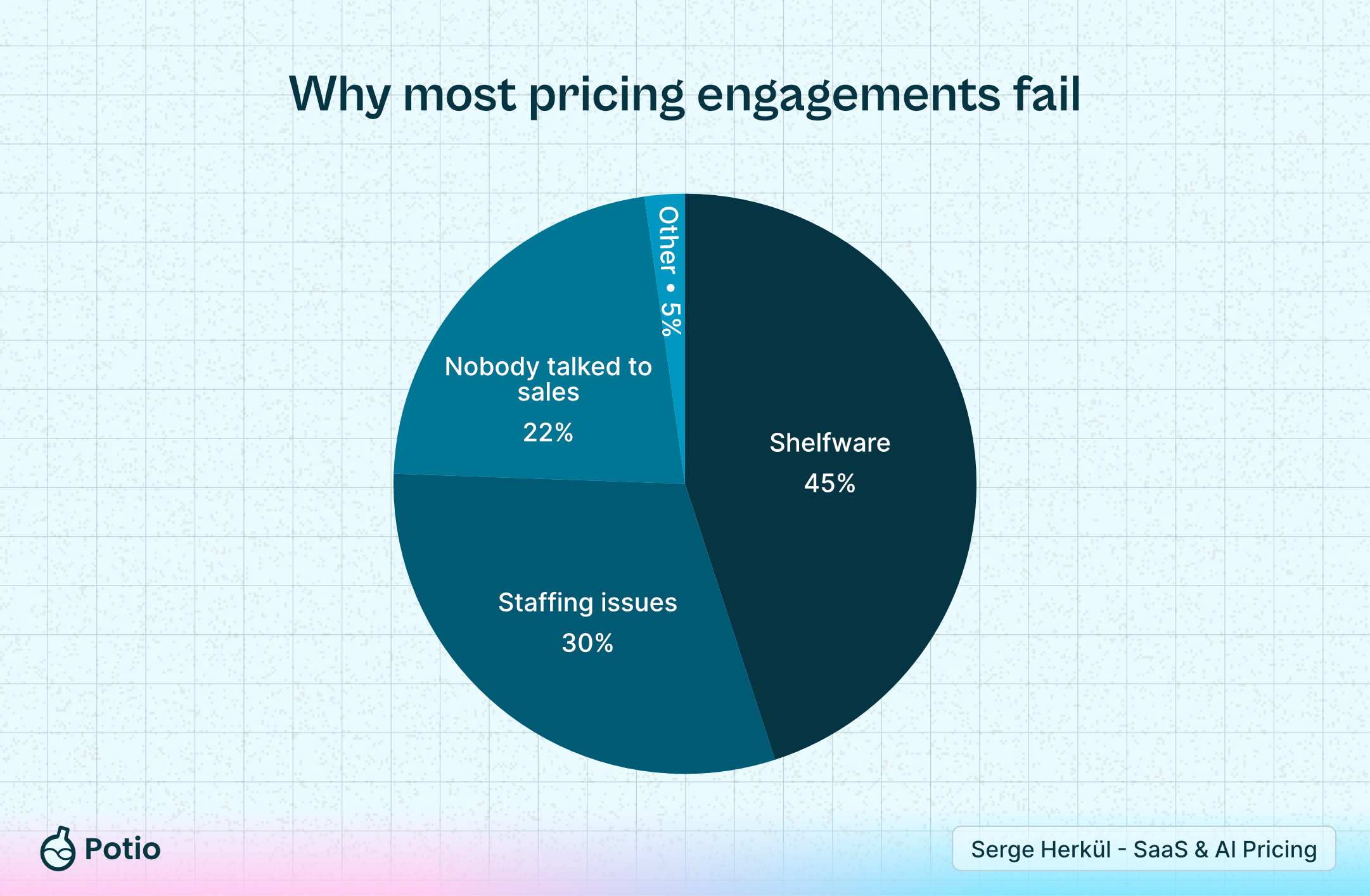
Shelfware, roughly 45% of complaints. The engagement ends with an executive presentation covering willingness to pay, theoretical price curves and high-level tiering. What it does not contain is the operational layer: migration rules for existing accounts, exact product gating definitions, a billing system schema, contract language for sales order forms. The strategy can be correct yet unusable, so it goes in a drive and the prices stay where they were.
Staffing issues, roughly 30%. Senior partners with real sector depth run the pitch. Delivery goes to an engagement manager and early-tenure analysts who may never have worked in your industry. Your team spends the first three weeks educating the consulting team at full enterprise billing rates.
This is the pattern I have seen most, and it is structural. Nobody involved is doing a bad job. When you hire a large firm you are one of a hundred live projects. Nobody there loses sleep over your pricing. They run their process, they deliver on schedule, they move on. That is a reasonable way to operate a firm with thousands of consultants and it is a poor fit for a company where pricing is the thing that decides the next two years.
Nobody talked to sales, roughly 20%. The model gets built in a room with the executive team and never touches the commission plan of the people who have to sell it. So list prices rise, discounting gets restricted, and account executives protect their hit rate by routing around the new rules. Within two quarters the exceptions are the policy again. Unless the engagement redesigns comp and coaches the deal desk, the pricing does not survive contact with the sales floor.
The remaining complaints, roughly 5%, are recommendations that require telemetry or metering the client’s infrastructure cannot support. Small in count, expensive in consequence.
Who owns whom
The specialist tier is no longer a set of independent partnerships. Private equity has spent eight years rolling it into tech-enabled platforms aimed at portfolio value creation, and almost nobody writing about these firms mentions it. It matters for two reasons: ownership decides what the firm is incentivized to sell you, and the firm you hire this year may be inside a different group by the time the work lands.
| Date | Event | Acquirer | Firm | What changed |
|---|---|---|---|---|
| 2017 | PE buyout | Align Capital Partners | Insight2Profit | Institutionalized the PE sponsor sales model, expanded the DRIvE platform |
| Apr 2022 | Merger and recapitalization | Boathouse Capital | Carlisle & Company and Ducker Worldwide | Created Ducker Carlisle, combining supply chain benchmarking with parts pricing |
| 2021 to 2022 | PE platform buyout | Blue Point Capital Partners | Stax | Scaled commercial due diligence, acquired AMR International in London |
| 2022 | Secondary buyout | Wind Point Partners | Insight2Profit | Expanded tech-enabled pricing managed services across mid-market PE portfolios |
| May 2025 | Cross-border merger | Boathouse Capital and Ducker Carlisle | Munich Strategy | Doubled European presence in manufacturing and building materials |
| Sep 2025 | Trade sale | Grant Thornton Advisors | Stax | Folded diligence and value creation into Grant Thornton transaction advisory |
Simon-Kucher, McKinsey, BCG, Bain, L.E.K. and Alexander Group remain partner-owned. Accenture is publicly traded. Everything in the mid-market specialist tier has changed hands at least once.
A private equity owned specialist that also sells a software subscription has a commercial reason to conclude that you need the software subscription. That does not make the analysis wrong, and it does mean you should read the recommendation knowing where the recurring revenue sits.
How to choose a pricing consulting firm
Work through it in this order, because the first two questions eliminate most of the list before preference enters the picture.
Start with the floor, not the shortlist. Under $20 million ARR, the global strategy firms and Simon-Kucher are not realistically available and you should stop considering them. Between $50 million and $1 billion in revenue, the mid-market specialists become the natural tier. Above $500 million with a genuine enterprise-wide transformation, the strategy firms earn their fee, because a single point of price realization across that volume is worth tens of millions in EBITDA and $1.2 million is a rounding error against it.
Match the sector, not the brand. Use the archetype table above. A firm with deep automotive aftermarket data is not a better choice for your API pricing than a boutique with no brand recognition and ten shipped usage-based migrations. Ask for two engagements in your exact model, not your broad industry.
Ask who does the work, by name. Get the delivery team on paper before you sign, with tenure and relevant sector projects. If the people in the room during the pitch are not the people delivering, you have found the 30% failure mode in advance.
Ask what lands on the last day. Deck only, or deck plus migration rules, gating definitions, billing schema and contract language. This single question separates a project that changes your revenue from one that changes your slide library.
Ask whether it ends in a subscription. Some engagements conclude with a platform you are now paying for monthly. Know that going in.
Check whether the data exists. Conjoint and elasticity work needs volume. If you have a few hundred customers and a year of billing history, a research-heavy engagement will produce confident output from thin input, which is worse than no output.
When you should not hire anyone yet
Three cases where the honest answer is to wait.
You are pre-product-market-fit. Pricing changes nothing while the product is still moving, and you will redo the work in six months anyway.
You have never run a price change. The first one is not hard to attempt and you learn things about your customers that no external party can tell you. Raise prices on new customers only, watch the conversion rate, and you have real data instead of survey data.
Nobody internally owns the outcome. A pricing project with no executive sponsor produces a document and no change. Fix that first or the fee is wasted at any tier.
Where Potio fits
I run Potio, a pricing consultancy for SaaS and AI companies. Clients are usually between $1 million and $100 million ARR, and the work is on the pricing model itself: credit systems, usage-based migrations, commitment ladders, packaging for AI features where the cost of delivery moves with usage. Engagements start at $8,500 for early stage companies and run to $40,000 and up for scaleups with more stakeholders in the room.
I can rebuild the pricing, and I can stay on afterwards as a fractional director of pricing to get it rolled out. That second half is where most of these projects die, whoever built the model.
I ran Toggl as CEO before this and founded multiple other companies, so what you get is an operator’s read and a deliverable built to be shipped.
What Potio is not for. Industrial distribution, automotive parts, physical retail, anything needing ERP transaction analysis across a large SKU catalog. Companies above roughly $100 million ARR running an enterprise-wide pricing transformation with a change management workstream, where a larger firm genuinely fits better. Pre-product-market-fit companies, where the work will not hold. And I do not help consultancies price their own services. That is a different business entirely.
Four things that settle it
The pricing consultants market is not one market. It is five tiers with barely overlapping price bands, methodologies that do not travel between sectors, and engagement floors that decide most of the question before you have opinions about it.
Four questions get you to an answer. What tier does my revenue put me in. Has this firm done my exact pricing model, not just my broad industry. Who delivers the work, by name. What lands on my desk on the final day.
Answer those and the choice usually makes itself. Skip them and you find out in week ten that the recommendation cannot be built.
Frequently asked questions
What does a pricing consulting engagement involve?
The shape depends on the tier. A global strategy firm runs 8 to 12 weeks with an engagement manager, two or three analysts and part-time partner oversight, producing segmentation, econometric models and an executive recommendation. Simon-Kucher runs 10 to 14 weeks centred on willingness-to-pay research, discrete choice conjoint and packaging design. Mid-market specialists run a 12 to 16 week diagnostic on your ERP transaction data, then hand off to an ongoing monitoring retainer. Boutiques run 2 to 6 weeks of direct work with the principal on a specific decision. Across all of them, the useful question is whether implementation artifacts are in scope or whether the engagement ends at the recommendation.
What are the alternatives to Simon-Kucher for a company under $50M ARR?
Below that line you are generally looking at the specialist boutique tier, which covers firms like Wiglaf Pricing for industrials, Revenue Management Labs for consumer goods and trade spend, Boston Pricing Group and Potio for software and AI, and Pricing Solutions for structured willingness-to-pay research. Consultport is an option if you want a single ex-MBB independent for a short mandate at $20,000 to $60,000 instead of a firm. The trade you are making is brand weight and research volume for senior delivery and a fee that does not need board approval.
Is a boutique pricing consultancy riskier than a large firm?
The risks are different rather than larger. A boutique gives you the senior person and carries key-person risk, a thinner research capability and no bench if scope expands. A large firm gives you methodology, data assets and institutional weight, and carries the delegation risk that shows up in roughly 30% of documented buyer complaints. On a project the size of a pricing change, the person doing the work usually matters more than the logo behind them. Push hardest on the delivery team question.
Should I hire a pricing consultant or hire a pricing person in-house?
A full-time pricing hire makes sense once pricing becomes a standing function instead of a project: frequent packaging changes, deal desk governance, a discount policy that needs enforcing, several products with interacting models. Below that, the work is episodic, and a good in-house hire is expensive and under-used between decisions. A common sequence is to bring in outside help for the architecture, then hire someone to run and maintain it once the model is stable.
How long does a pricing project take?
Two to six weeks for a boutique sprint on a defined decision. Four to ten weeks for a hypothesis-driven strategy team. Eight to twelve weeks for a standard global strategy engagement, and 10 to 14 for Simon-Kucher’s full cycle. Twelve to sixteen weeks for a mid-market diagnostic on transaction data, and six to eighteen months for a Big Four programme that includes systems integration. Add your own implementation time to any of these, because that clock starts when the consultants leave.
What should a pricing consultant deliver that a strategy deck does not?
The operational layer. Migration rules stating what happens to each existing cohort and when. Product gating definitions precise enough for an engineer to build from. A billing schema that maps to whatever you meter on. Contract and order form language for the sales team. A compensation plan that pays people to sell the new prices rather than route around them. If none of that is in the statement of work, the engagement ends at the recommendation and the harder half of the project is still yours.
Let's fix your pricing
Potio is a pricing consultancy for SaaS and AI companies.
Get a complete pricing redesign
and a clear rollout plan in one structured sprint.